Hydro-Jetting vs. Snaking: Which Does Your Drain Need?
A snake pokes a hole through a clog. A jetter scrubs the pipe wall, and a camera tells you which one you need.
October 20, 2026 · 4 min read
When a drain backs up, the first fix is usually the one everybody knows: run a cable through it and break the clog loose. It often works, and then the drain is slow again six weeks later. That pattern is the clue that something is still coating the pipe walls. Hydro-jetting and sewer cameras exist for exactly that situation.
What a snake or rooter does
A drain snake, or rooter machine, is a rotating cable with a cutting head. It's driven into the pipe until it hits the blockage, then spins and chops through it. That's very effective on tree roots and on a hard plug of debris. The result is a hole through the middle of the obstruction, enough to get water moving again.
What a rooter doesn't do is clean the pipe. Grease, scale and sludge that built up along the walls are still there, now with a channel through the middle. The pipe is open but narrow, and the next buildup will close it faster than the last one did.
What hydro-jetting does
Hydro-jetting uses a hose with a special nozzle and water pressure up to 4,000 PSI. The jets point backward and forward, pulling the hose down the pipe while the water scours the inside wall. It doesn't just open a path through the blockage. It cleans the inside of the pipe. Hydro-jetting can remove:
- Grease and fat that has hardened along the pipe wall.
- Food and organic waste stuck in the line.
- Scale and mineral deposits that narrow the pipe over the years.
- Sludge and heavy buildup that a cable would only push around.
- Debris left behind after rooter service has cut a path.
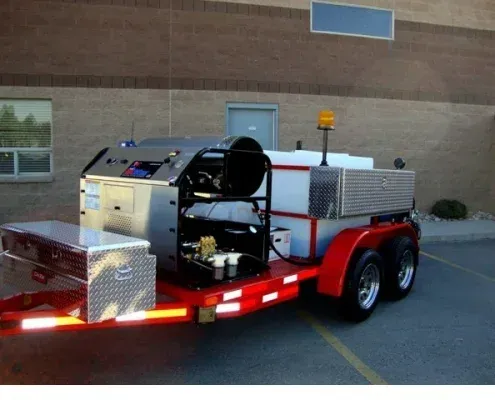
That last point is why the two services are often used together. A rooter clears the roots or the plug, then the jetter flushes out what was left so the cut pieces don't pile up downstream. AWR runs a trailer-mounted hot-jet unit for this work.
When to use which
As a rough guide, a single stoppage in an otherwise healthy line is often a rooter job. A line that keeps slowing down is usually a jetting job. Roots almost always call for the cutting head first. Kitchen drain lines coated with grease respond best to jetting, since cutting through fat just leaves a tunnel in it. And if you've had the same drain snaked more than once in a year, stop treating it as a series of separate clogs. Something is going on in that pipe that needs to be seen.
Why a sewer camera comes first
Sometimes the right move is neither one. A sewer camera is a small waterproof camera on a flexible cable that is fed through the line, sending a live picture to a monitor. It shows what the pipe actually looks like, which no amount of guessing can. A camera inspection can find:
- Cracked or damaged pipe.
- Root intrusion at the joints.
- Grease buildup, and how thick it is.
- Separations where two sections of pipe have pulled apart.
- Bellies, which are low spots where water and solids sit instead of flowing.
- Foreign objects stuck in the line.
- The places where blockages keep recurring.
This matters because the fix depends on the cause. Grease and scale are a job for the jetter. Roots are a job for the cutter. But a cracked pipe, a separated joint or a belly will keep clogging no matter how often you clean it, and the sooner you know that, the sooner you can plan a real repair instead of paying for the same cleanout over and over. The camera is also a good idea with older plumbing, when you're buying a building, or after repeated backups with no obvious reason.
A restaurant example
One restaurant customer wrote in a Google review that another local company hadn't been able to fully fix their drain trouble, and that American Waste Removal cleared it after they called. They had used us for grease trap cleaning for years without realizing we also handle drain clearing. It's a common blind spot: a company that pumps grease traps usually has the jetting and camera equipment to find out why the lines downstream are misbehaving, and it makes sense to use one crew who can see the whole system.
What to expect on the call
Tell the dispatcher what the drain is doing, how long it's been going on and whether it has happened before. If it's a repeat problem, say so, because that's a good reason to start with the camera. For an emergency backup, say that too. The crew will usually clear the line first to stop the damage, then recommend a camera pass or jetting to deal with the cause.
Ready to find out what is in your line?
AWR does rooter service, hydro-jetting and sewer camera inspections for homes, restaurants and commercial buildings, around the clock when it can't wait. Call (505) 344-0177 and tell us what the drain is doing.
American Waste Removal, (505) 344-0177
Call (505) 344-0177More articles
How Often Does a Commercial Grease Trap Need Pumping?
Every one to six months is the usual range, and where your kitchen lands depends on what goes down your drains.
Grease Trap vs. Grease Interceptor: What Each One Does
Both keep grease out of the sewer, and both do it only until they're full.